
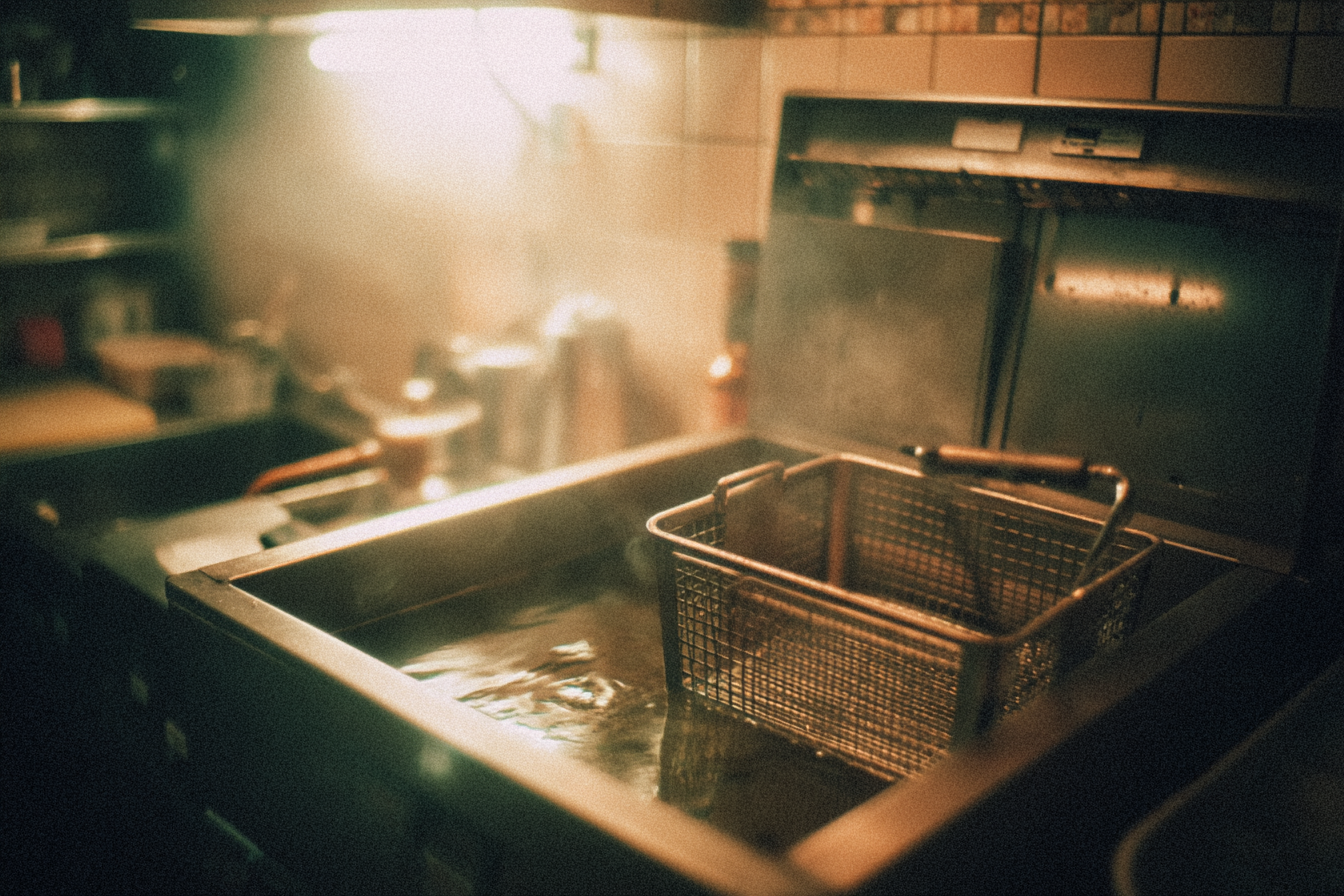
Dedicated vs Shared Fryers
Why shared oil makes naturally gluten-free food unsafe, and how to ask about it.
Nothing in a kitchen carries gluten as efficiently as hot oil. It’s invisible, it’s shared by default, and it turns naturally gluten-free food — potatoes, artichokes, squid, chickpeas — into food a celiac cannot eat. No ingredient changes. Nothing appears on the menu. The dish is exactly what it says it is, and it is still not safe.
What Shared Oil Actually Does
Frying doesn’t destroy gluten. It distributes it.
Every breaded item dropped into a fryer sheds. Batter, flour, crumbs, and the gluten proteins inside them separate from the food and disperse through the oil. Some settles at the bottom. Much of it stays suspended, circulating for as long as that oil is in service.
Heat does not solve this. Gluten is a stable protein — frying temperatures do not break it down into something the immune system stops recognizing. Oil at 180°C is not a sterilizing agent, and the gluten that entered it at eleven in the morning is still there at eight in the evening.
Filtering does not solve it either. Commercial fryer filtration is designed to remove visible sediment and extend the life of the oil. It is not designed to remove dissolved or suspended protein, and it does not.
Which leaves only one thing that works: oil that has never had gluten in it.
The Most Common Wrong Answer
This is the most common misunderstanding in gluten-free dining, and it is usually offered in good faith. A kitchen wanting to help will pull out a clean basket, or a fresh basket kept aside for allergy orders, and lower it into the same oil everything else is cooked in.
The basket was never the problem.
A clean basket in dirty oil is still dirty oil.
A dedicated fryer means dedicated oil — a separate vessel, holding oil that has never cooked anything containing gluten, and won’t for as long as it’s in use. Anything short of that is a shared fryer with extra steps.
The same applies to “we change the oil daily.” Fresh oil at open is contaminated by the first breaded item that goes into it, which in most kitchens is within the first hour of service.
The One Question
“Is there a separate fryer, with separate oil, used only for gluten-free food?”
We ask about the fryer before we ask about the menu. It’s the fastest way to know what a kitchen really is.