Italy vs Spain for Gluten-Free Travel
The question comes up often, usually from travelers who have done enough research to know that both countries are possible, but not yet enough to know how they differ.
Italy or Spain?
It's a reasonable thing to wonder. Both have strong culinary cultures, genuine celiac awareness, and the kind of food that makes international travel feel worthwhile. But they operate on different principles, and understanding that difference matters more than a simple ranking of which is safer.
This isn't a comparison between a good option and a bad one. It's a comparison between two systems — and which one fits you depends on who you are as a traveler.
Italy's advantage is structural.
The Associazione Italiana Celiachia has spent decades building something durable: a national training program that certifies restaurants in cross-contact prevention, dedicated preparation areas, separate fryers, allergen protocols, and ingredient sourcing. When you walk into an AIC-affiliated restaurant in Rome or Florence or Bologna, you're walking into a kitchen that has met a verified standard. The infrastructure often protects you before you've asked a single question.
What this produces, in practice, is a kind of ease that celiac travelers rarely experience elsewhere. You can order pasta confidently. You can find gluten-free pizza with a separate dough, fried appetizers cooked in dedicated oil, a bakery counter where you can point at something and simply order it. The calculus that typically runs quietly in the background — what's in the broth, is the fryer shared, did they understand the question — softens considerably. Major cities have fully gluten-free bakeries. Supermarkets carry robust certified product lines with clear labeling. The category of things that require careful confirmation shrinks.
For someone newly diagnosed, or traveling internationally with celiac disease for the first time, or carrying higher cross-contact sensitivity, Italy tends to feel like relief. Not because every kitchen is perfect, but because the system was built with you in mind.
Spain operates differently, and the difference is worth naming clearly rather than framing as a deficiency.
The Federación de Asociaciones de Celíacos de España has done meaningful work — allergen labeling laws are strong, many restaurants understand celíaco without translation, and gluten-free bread has become genuinely common in urban dining. Spain is not a country where awareness is low. It's a country where the institutionalized kitchen-level training varies more widely, and where the culture of eating creates specific dynamics worth understanding before you arrive.
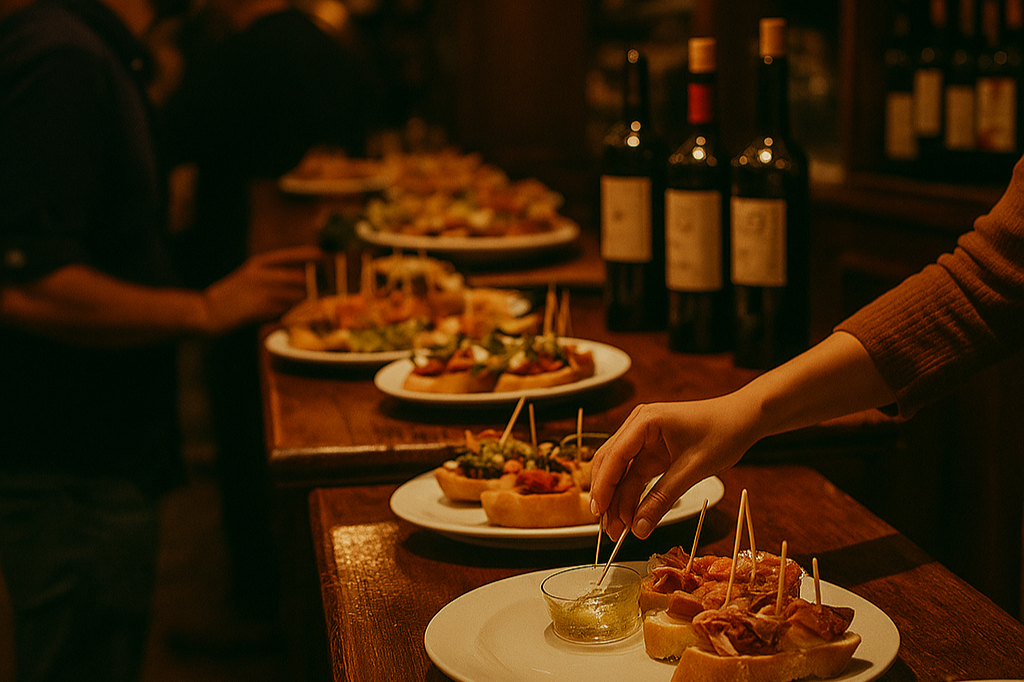
Tapas culture is part of what makes Spain so compelling — the sociability of it, the way a meal becomes a series of small decisions shared around a table. It's also what introduces complexity for a celiac traveler. Small kitchens, shared fryers, busy bar environments, plates moving quickly — the conditions that make cross-contact prevention harder to guarantee are built into the format. Patatas bravas, a dish that might seem straightforwardly safe, often comes from a fryer that has held breaded items all evening. Paella, naturally gluten-free in its traditional form, requires a specific question about the broth. The dishes are navigable. They simply require you to initiate the conversation rather than assume the system has handled it.
Spain rewards travelers who are comfortable asking direct questions and who lean naturally toward the dishes that carry less inherent risk — jamón, fresh seafood, tortilla española, grilled proteins. The experience can be genuinely excellent. It asks more of you than Italy does.
The emotional texture of each country is worth considering too, because it shapes more than just individual meals.
Traveling through Italy with celiac disease often produces something unexpected: the quiet realization, somewhere in the middle of a bowl of pasta or a plate of fried zucchini flowers, that you stopped calculating. That the meal became simply a meal. That sense of participation — in iconic food, in local culture, without the weight of negotiation — is what makes Italy such a reliable recommendation for travelers who find the mental load of eating abroad genuinely tiring.
Spain feels different. More conversational, more active, more reliant on the connection you build with a kitchen or a server. For travelers who have learned to navigate gluten-free dining abroad with confidence, who don't carry significant anxiety into the process, Spain's variability becomes part of the pleasure rather than a source of stress. You build your table intentionally. You ask, you confirm, you eat well.
Neither approach is wrong. They require different energy, and only you know which one you have more of on a given trip.
If you're trying to choose, the deciding questions are practical ones. How much does fried food matter to your experience? How comfortable are you initiating detailed kitchen conversations in a second language? Are you traveling early in your celiac diagnosis, or have you been navigating this for years? Do you want the system to carry most of the weight, or are you prepared to carry some of it yourself?
Italy for structure. Spain for navigation. Both, when approached with intention, for an exceptional trip.
The Takeaway
Italy's AIC training system provides institutional protection before you ask — certified kitchens have met a verified standard for cross-contact prevention, dedicated fryers, and allergen protocols.
Spain has strong celiac awareness and labeling laws, but kitchen-level cross-contact protocols vary more widely; expect to initiate more confirmation conversations.
Tapas culture — small kitchens, shared fryers, fast-paced bar environments — creates specific cross-contact dynamics in Spain that require attentiveness, particularly around fried foods.
Italy tends to feel like relief for newly diagnosed travelers or those with higher cross-contact sensitivity; Spain rewards travelers already confident in navigating gluten-free dining abroad.
In both countries, supermarkets are well-labeled and carry strong gluten-free product lines — apartment stays work well in either destination.
The better question isn't which country is safer, but which system matches your comfort level and travel style on this particular trip.